Years ago, long before I was an instructor or a Construction Safety Officer, I witnessed an exchange that changed how I view professional integrity forever.
A Supervisor wanted to get his quad on the company payroll to increase his pay from the project. There was one catch: he needed a quad certification. Unwilling to actually attend the training, he contacted an instructor and asked to “just pay” for the certificate. The instructor agreed, sent the paper, and arranged to collect the cash later.
When the instructor finally came for his money, the Supervisor just laughed.
“No,” he said. When the instructor balked, the Supervisor leaned in. “What are you going to do? Report me to the Board? Tell them you issued a fraudulent certificate? F@#k off, you clown.”
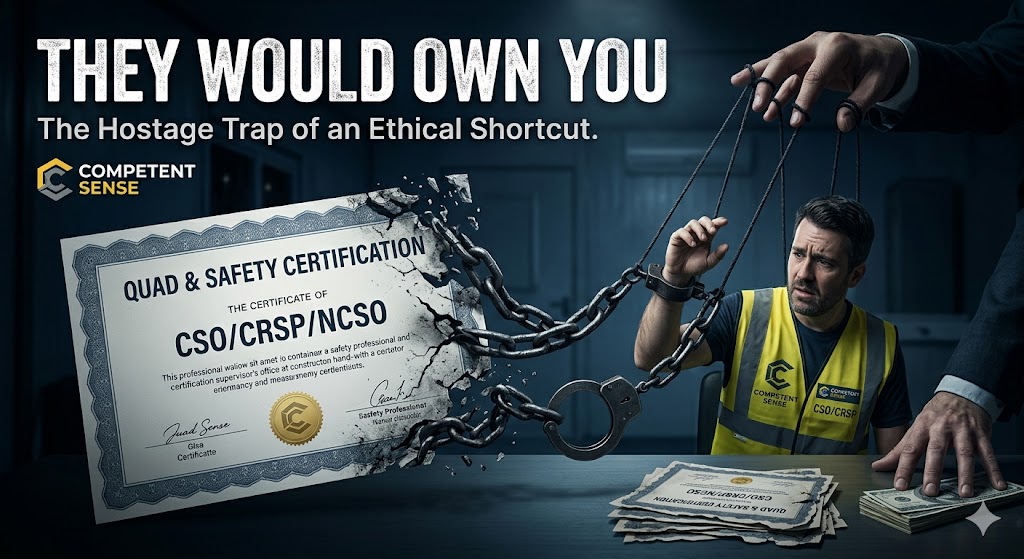
The Trap Snaps Shut The instructor left empty-handed, but it didn’t end there. Three years later, just before that certificate was set to expire, the Supervisor called again. He demanded a new certificate for himself and one for a friend.
“If you don’t,” the Supervisor warned, “I’ll rat you out for the one you gave me three years ago.”
Over a barrel and terrified for his career, the instructor did exactly what he was told. He was no longer a professional; he was a subordinate to a criminal.
The Real Cost of a Shortcut There are plenty of legal and ethical reasons not to sell certificates. But here is the one people rarely talk about: If you sell a certificate without the training, you are selling your freedom.
Whether you hold a CSO, NCSO, or CRSP, that designation is your livelihood. It represents decades of effort, education, and money. If you break the ethical code, you aren’t just out of a job; you are out of a career.
I cannot imagine sitting my family down to explain that the career we built together is gone—all because I couldn’t say “no” to a shortcut.
Whenever someone asks to “just pay for the certificate” or “just skip the exam,” the answer is simple and direct: No. It isn’t just about the rules. It’s Competent Sense.
Leave a Reply